
On exploring the limitless opportunities storytelling skills can provide
Written by Nala Ortiz
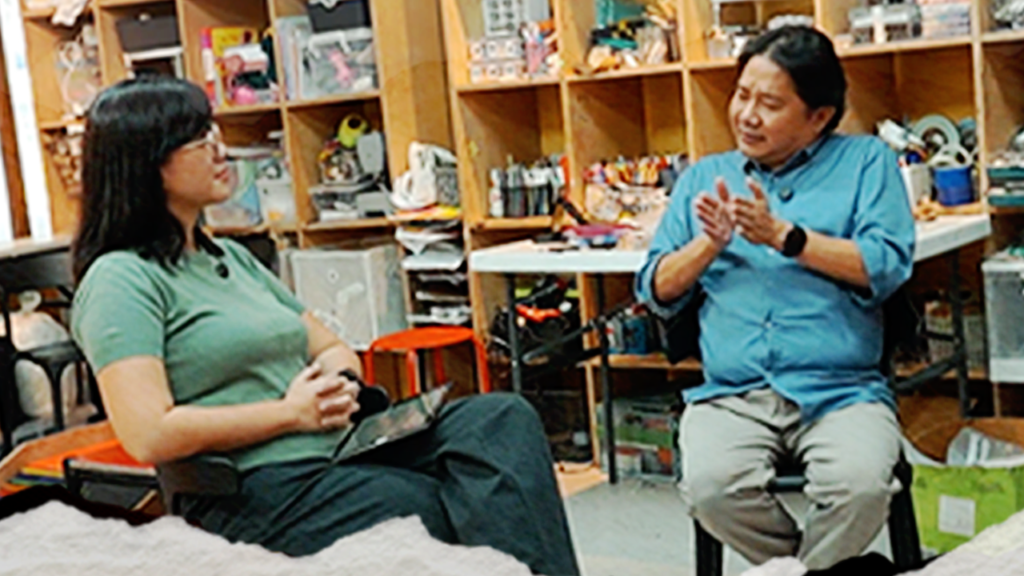
The ability to tell a good story is a timeless skill — whether you’re teaching a class, leading a team, or engaging your audience at improv night. Gabe Mercado has spent decades mastering the art of storytelling, using his improv roots to help others communicate with empathy and authenticity. Now, through his work with Vivita, Koppett, and beyond, Gabe is shaping the next generation of creative thinkers and makers.
For creatives who are fully investing in their craft and seeking to build — or perhaps even burn bridges, this episode of Nagmamahusay offers a lesson in growth, connection, and leadership that values legacy over ego.
The need for a creativity incubator/accelerator
Gabe co-founded Vivita, a creativity accelerator, incubator, and makerspace for kids aged eight and up — a sandbox designed to cultivate curiosity and problem-solving skills where traditional schools may fall short on.
“There’s research showing that if kids don’t develop an interest in science, tech, engineering, or math before age 12, it’s much harder to engage them later,” he explains. Vivita aims to fill that gap in an accessible way. “We incubate different interests of the kids so that they become the innovators of tomorrow.”
More than just a local initiative, Vivita is part of an international network of makerspaces on a shared mission: nurturing creativity not just in arts but also in sciences. “Imagine a scientist with the imagination of an artist, or an artist with the rigor of a scientist—what might they create?”
Is improv a powerful, transferable skill? Yes! And…
Nobody is a stranger to impostor syndrome, including Gabe. But true to his improv roots, he makes sure he’s prepared to the brim. Contrary to the myth that improvisers just ‘make it up,’ Gabe insists, “A good improviser prepares to death.” Mastery comes from rigorous learning and rehearsal. Only once fully prepared can you truly let go on stage, trusting your instincts to navigate the moment. This discipline, he says, trains creatives to become comfortable with failure and uncertainty.
Gabe also works with Koppett, a New York-based organization with members worldwide that helps corporations sharpen their communication skills through improv techniques. “It’s more important for leaders right now to learn how to communicate authentically, with credibility, with empathy,” he expressed.
Gabe also acknowledges the differences that artists and corporate employees have, but encourages both to step into each other’s shoes – that way, artists can learn marketability skills from corporate employees, and in turn, corporate employees can apply creative principles and practices into their line of work.
“If you don’t learn the language of the corporate world—their pain points, their objectives—you might miss out on steady income and wider impact. For artists, try to think of yourselves as designers with an objective to solve a certain problem. A designer uses their artistic toolbox to fulfill specific goals and create value.”
Letting go to grow a creative legacy
At age 40, Gabe made a pivotal choice—leaving Manila’s stress behind to move to Baguio. “I realized if I didn’t do it then, I might never have the courage.” He explained that this move was partly driven by his father’s motto: “Always reinvent yourself; don’t congeal.”
His departure from the busy metro also marked a transition for SPIT, the improvisation group he founded. “Our goal was always to build the next generation, to outgrow us.” Gabe views stepping back not as losing control but as enabling SPIT to thrive beyond him. “If it was about me, baka wala nang improv. But now it’s so much bigger than what it would have been had I stayed.”
Language shapes value — ditch the word “raket”
“Stop calling side projects ‘raket’!” Gabe exclaimed. The slang term comes from the word “racket,” which originally implies scamming or hustling at others’ expense. “It’s about respecting your work by providing real value to clients at a level of excellence you can be proud of.” He encourages artists to see their careers as portfolios, and use the terms “fractional work” and “side projects” to give their work more value and integrity.
For Gabe, networking beyond the Philippines is vital. He recommends joining industry groups and online networks such as LinkedIn to build credibility without sacrificing authenticity. “Work with people who genuinely know more than you and be intentional about growing your career.”
Gabe concludes the podcast episode by looking ahead at the creative economy of the Philippines, where he sees real promise. “If we are able to create institutions that focus on forming talents and bring them to a world standard (…) imagine how much better our creative industries will be.”