
It takes a village to nurture a creative — and a nation’s populace to build and protect its culture
Written by Nala Ortiz
You’ve probably heard of the African proverb, “It takes a village to raise a child.” It feels simple and true, yet when you try to put it into practice, you realize how complicated it really is. Creating a strong, supportive network where curiosity and creativity can thrive takes time, patience, and a shared belief in something bigger than yourself.
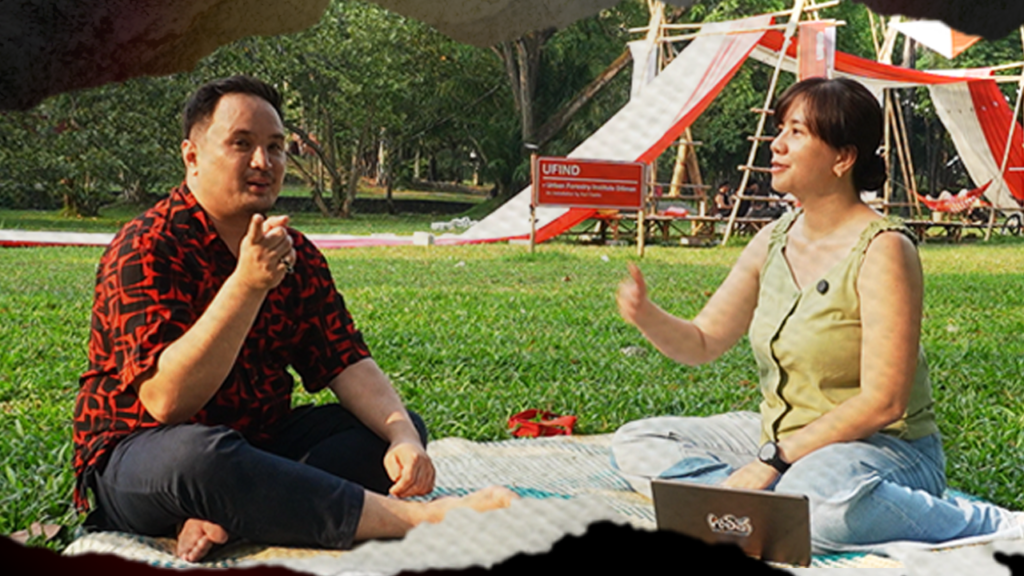
This idea comes vividly to life in this episode of Nagmamahusay, a podcast by Husay.co, where we meet Karl Castro — an artist, designer, educator, activist — and a creative nurtured by family and community that helped strengthen his convictions.
Karl’s upbringing shaped his unique artistic prism. He grew up in Angono, Rizal, a town famous for its vibrant art scene and home to two national artists. Moreover, his family kept close to their interests in the humanities — with his grandmother being an avid collector of National Geographic magazines, and his mother having worked closely with creatives in an advertising agency.
Art and design were not the only things Karl got exposed to at an early age — he became highly aware of his privilege early on. He witnessed vast lifestyle differences in high school; families living in marginalized neighborhoods made him see the wide gap between the rich and the poor; and his experience during his time as a student of the University of the Philippines and in the Philippine Collegian gave him the opportunity to meet peasant farmers and visit workers’ strikes.
From there, Karl realized: “Lumaki yung mundo ko. Nakita ko talaga na ang daming nangyayari na hindi nakikita ng mga tao. I think doon talaga nagbago ‘yung pananaw ko sa kung ano ba ‘yung dapat kong gawin sa mundo. Kasi once you see those issues, hindi ka na mabubuhay nang parang hindi mo ‘yun nalaman.”
Karl currently serves as a professor of art and design, and is a proactive board member of the Concerned Artists of the Philippines, where he passionately advocates for freedom of expression, human rights, and artists’ rights. His experiences as an educator and activist have shaped key insights that he believes should guide today’s creatives:
Don’t be afraid to take the first step; you’ll find your rhythm anyway
When it comes to his personal aspirations, Karl keeps things grounded yet intentional. “What I aspire for is to be able to do the things I want to do,” he says. Balancing the realities of survival, money, and stability, Karl searches for projects with different kinds of value:
- Advocacy projects: Work that aligns deeply with his values—even if they don’t offer financial compensation.
- Financial anchors: Projects primarily for income, where one may give up certain creative decisions in exchange for stability.
- Skill and social investment projects: Those that might not pay much, but provide opportunities to expand his network and build a strong reputation.
Sometimes, a shift in perspective is what you need to grow and move forward
Karl often advises those carving out their creative paths, “You also have to treat yourself as a client.” He believes a part of an artist’s practice must be self-initiated because constantly following client demands risks losing your creative identity. “Your values should be the ones leading the project,” he explains.
Additionally, he urges creatives to go beyond simply making work to learning how to explain and communicate it. “You need to be able to write about your work, (and) explain it.” This means understanding how your materials and concepts interact—treating the process as a form of research—and allowing your audience to engage with your work on multiple levels, not just visually.
Cultivating culture is a collective act
Karl’s activism deepens his belief that the responsibility to nurture culture lies not just with individuals but with the state and wider society. He paints a stark, yet truthful picture of Metro Manila: “No sidewalks, no efficient public transportation, no green spaces. It’s so hard to just exist and live; basic requirements of a dignified life, wala talaga.” Cultural spaces often show up as basketball courts or malls, while freedom parks require government permission, which undermines their purpose.
“Democratic space and democratic rights are always shrinking and being taken away from us,” Karl warns. “If you don’t fight for them, they really disappear — you can’t be complacent.” For him, culture is ultimately shaped by the people, whose voices the government is supposed to represent. “The government should be the voice of the people,” he asserts. “It’s really the state’s big responsibility to create these spaces and to deeply support culture.”
Karl’s installation, the Urban Forestry Institute in Diliman (UFIND), reflected this belief in the search for dignity in public spaces. Mounted in March, UFIND became a place for people to commune, relax, and interact. The installation was taken down in July, and culminated in an event called “PLACE and PRESENCE: What we found at UFIND,” where he remarked: “To leave no trace–except, perhaps, in the archive, in memory–is its own kind of freedom.”
He is confident in Filipino talent, describing it as “rich, hardworking, inventive.” Yet, he acknowledges that governance issues hold back potential. “We need systems that allow talent to bloom. There’s still a lot of work to do.” For Karl, what creatives most need now are spaces—real, functioning cultural spaces where people can gather, organize, and shape their industries and practices.
“This isn’t just about business or making money,” he says. “It’s about the intangible benefits that culture brings to our lives.”
Looking ahead, Karl holds cautious but hopeful eyes on the future. “I think (the) Philippines will be in a much better position to be proud of its creative scene,” he says, explaining that it’s going to take all of us — artists, lawmakers, and audiences — to usher the country towards that goal.
